
Is PR Blend a Good Pre-Workout Coffee? What the Research Says (2026 Update)
Share
Yes, and the research is unusually clear about why: dose-matched coffee performs about as well as pure caffeine. In a 2013 randomized trial, coffee and straight caffeine both improved endurance performance by roughly 5.0% over placebo, while decaf did nothing. That's the whole case for using real coffee as a pre-workout instead of a scoop of powder.
Reviewed and published by Danny Lehr, CrossFit Level 3 Trainer and USA Weightlifting coach. Updated October 2026.
Key findings at a glance
- Coffee matched dose-matched pure caffeine for endurance performance, both about 5.0% faster than placebo. Decaf produced no benefit (Hodgson, Randell and Jeukendrup, PLoS One, 2013).
- The landmark 1978 trial moved cycling time to exhaustion from 75.5 minutes on placebo to 90.2 minutes on caffeine, a 19.5% increase (Costill, Dalsky and Fink, Medicine and Science in Sports, 1978).
- In trained lifters, caffeine raised reps to failure from 18.5 to 19.6 and lowered rated effort and muscle pain, with peak heart rate and lactate unchanged (Duncan et al., European Journal of Sport Science, 2013).
- The common research dose is about 3 mg per kg of bodyweight, roughly 205 mg for a 150 lb lifter and 245 mg for a 180 lb lifter.
- Timing matters more than most people think. A 400 mg dose 6 hours before bed still cut measured sleep by over an hour in a 2013 trial, so put your caffeine early in the day.
Why is coffee a good pre-workout?
Because the caffeine in coffee works about as well as the caffeine in a powder. That sounds obvious, but it was an open question for years, and the 2013 trial that tested it head to head found no meaningful gap between dose-matched coffee and pure caffeine. Decaf, run as a control in the same study, did nothing. We wrote that one up in full here: coffee vs pre-workout caffeine.
How much PR Blend should I drink before training?
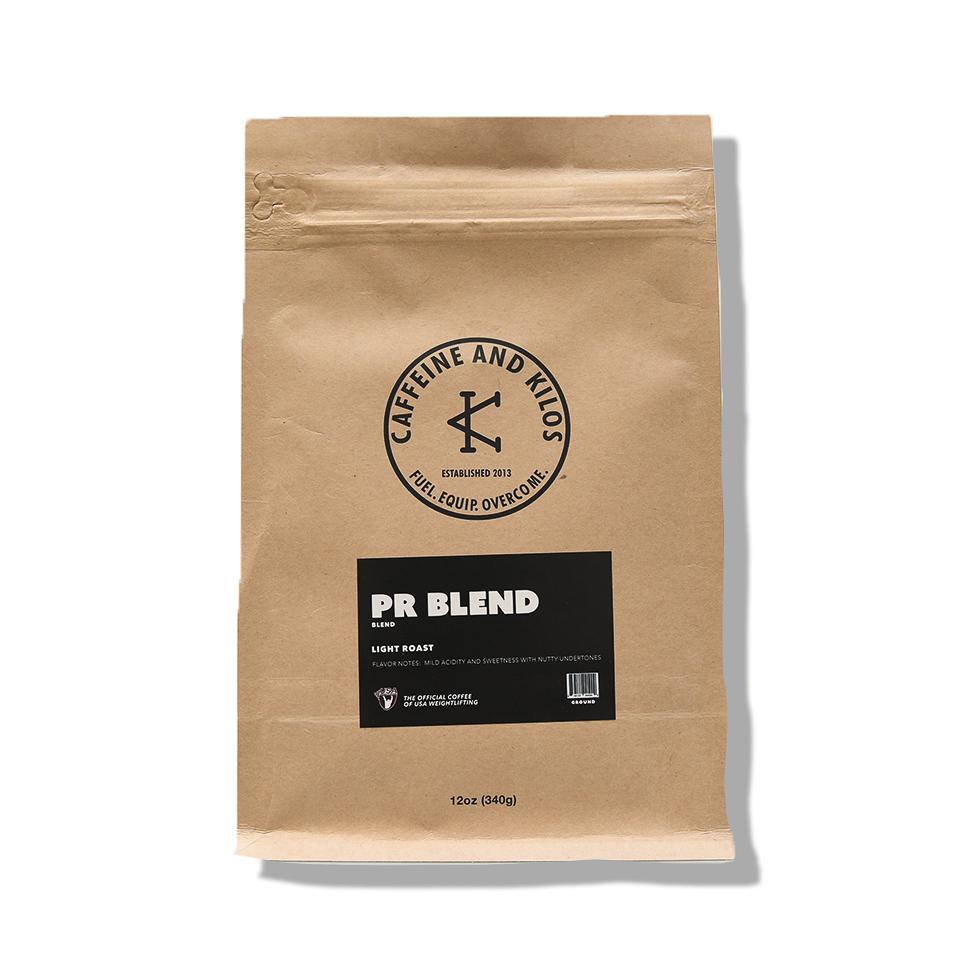
Most of the performance research lands on about 3 mg of caffeine per kg of bodyweight, which is roughly 205 mg for a 150 lb lifter and 245 mg for a 180 lb lifter. PR Blend carries about 50% more caffeine than a standard cup, so for most people that's one solid mug rather than three. Start at the low end, take it 30 to 60 minutes before you train, and see what you actually need before you add more. If you want to rotate what's in the grinder without rethinking this every month, the Coffee of the Month annual plan keeps fresh bags arriving, and the full coffee lineup covers the cups you drink for the taste rather than the training.
What does caffeine actually do in a workout?
It blocks adenosine, the molecule that builds up and tells your brain you're tired. The downstream effect that shows up most consistently in trials is that the same work feels easier. In the 2013 resistance training study, lifters got about one extra rep to failure and rated both their effort and their muscle pain lower, while peak heart rate and blood lactate didn't budge. The work didn't get easier. The reading of it did.
When should I stop drinking coffee if I train at night?
Earlier than you'd guess. A randomized trial gave 400 mg of caffeine 6 hours before bedtime and still measured more than an hour of lost sleep, and the participants couldn't feel it happening. If you train in the evening, front-load the caffeine into the morning and early afternoon. Full breakdown here: how long before bed should you stop drinking coffee.
Does coffee help you burn fat?
Careful here, because this is where most pre-workout marketing overreaches. Caffeine does shift fuel use toward fat in endurance work, and the 1978 trial measured fat oxidation rising from 0.75 to 1.31 g per minute. What that does not demonstrate is fat loss. Burning more fat during a ride is not the same thing as losing fat over a month, which is settled by total energy balance, not by what's in your mug.
How should I drink it?
Black is simplest and keeps the dose clean. Add creamer if that's what gets you to actually drink it. Blend it into a shake if that's your habit. None of that changes the caffeine, and the caffeine is the part doing the work.
What this does not prove
- These are small trials. The endurance studies ran 8 and 9 subjects, the lifting study 11. Real findings, modest samples.
- Every figure above comes from trained or recreationally active subjects. None of it is a promise about a specific person on a specific day.
- Caffeine improves how hard work feels and how long you can hold output. It does not build muscle, and no study here measured body composition.
- PR Blend has not itself been tested in a trial. What's been tested is caffeine, and coffee as a delivery vehicle for it.
FAQ
Is coffee as good as pre-workout powder?
For caffeine, yes. A 2013 randomized trial found dose-matched coffee and pure caffeine both improved endurance performance by about 5.0% over placebo, with no meaningful difference between them.
How much caffeine should I take before lifting?
Research protocols usually land around 3 mg per kg of bodyweight, about 205 mg for a 150 lb lifter and 245 mg for a 180 lb lifter, taken 30 to 60 minutes before training.
Does decaf work as a pre-workout?
No. Decaf was run as a control in the 2013 coffee trial and produced no performance benefit, which is what you'd expect if caffeine is the active ingredient.
Does coffee before a workout cause jitters?
It depends on your dose and your habitual intake. Jitters are usually a dose problem rather than a coffee problem, which is why starting near 3 mg per kg and adjusting from there beats guessing with a scoop.
How late can I drink coffee if I train in the evening?
Treat 6 hours before bed as a minimum. In a randomized trial, 400 mg of caffeine 6 hours before bedtime still cut measured sleep by more than an hour, and self-report missed it entirely.
Sources
- Hodgson AB, Randell RK, Jeukendrup AE. The metabolic and performance effects of caffeine compared to coffee during endurance exercise. PLoS One. 2013;8(4):e59561.
- Costill DL, Dalsky GP, Fink WJ. Effects of caffeine ingestion on metabolism and exercise performance. Medicine and Science in Sports. 1978;10(3):155-158.
- Duncan MJ, Stanley M, Parkhouse N, Cook K, Smith M. Acute caffeine ingestion enhances strength performance and reduces perceived exertion and muscle pain perception during resistance exercise. European Journal of Sport Science. 2013;13(4):392-399.
- Drake C, Roehrs T, Shambroom J, Roth T. Caffeine effects on sleep taken 0, 3, or 6 hours before going to bed. Journal of Clinical Sleep Medicine. 2013;9(11):1195-1200. PubMed abstract
This is research on groups of people, not medical advice.