
A Cup of Coffee Before Workout Helps You
Share
Yes, a cup of coffee before training helps, and the size of the effect is known: across 21 studies, caffeine made exercise feel 5.6% easier than a placebo did and improved performance by 11.2%. It sharpens focus, blunts the sense of effort that usually makes you back off early, and nudges fat oxidation. Here is what holds up and what does not.
Reviewed and updated by Danny Lehr, CrossFit Level 3 Trainer and USA Weightlifting coach, October 2026. Originally published December 2019.
The numbers, in one place
| Measure | Caffeine vs placebo | Statistically significant? |
|---|---|---|
| How hard exercise felt, during the work | 5.6% lower | Yes |
| Exercise performance | 11.2% better | Yes |
| How hard it felt at the point of exhaustion | No change (0.01%) | No |
From Doherty and Smith's 2005 meta-analysis of 21 studies. The comparison in every row is caffeine against a placebo taken before the session. The last row is the honest limit: all-out still feels all-out.
Coffee Before Workout Improves Focus
Caffeine works by blocking adenosine receptors in the brain. Adenosine is the molecule that accumulates as you work and tells your nervous system you are getting gassed. Caffeine is shaped closely enough to occupy those receptors without triggering them, so the fatigue signal lands quieter. That is the mechanism behind the focus, and behind most of the rest of this list.
Many people underestimate how much attention it takes to train well. To an outsider, pumping iron can look mindless. In practice, the people who make the most gains are the ones paying attention: to position, to bar path, to the difference between discomfort and a real stop sign. Caffeine before a session makes it easier to check in on the work and check out on the rest of your to-do list.
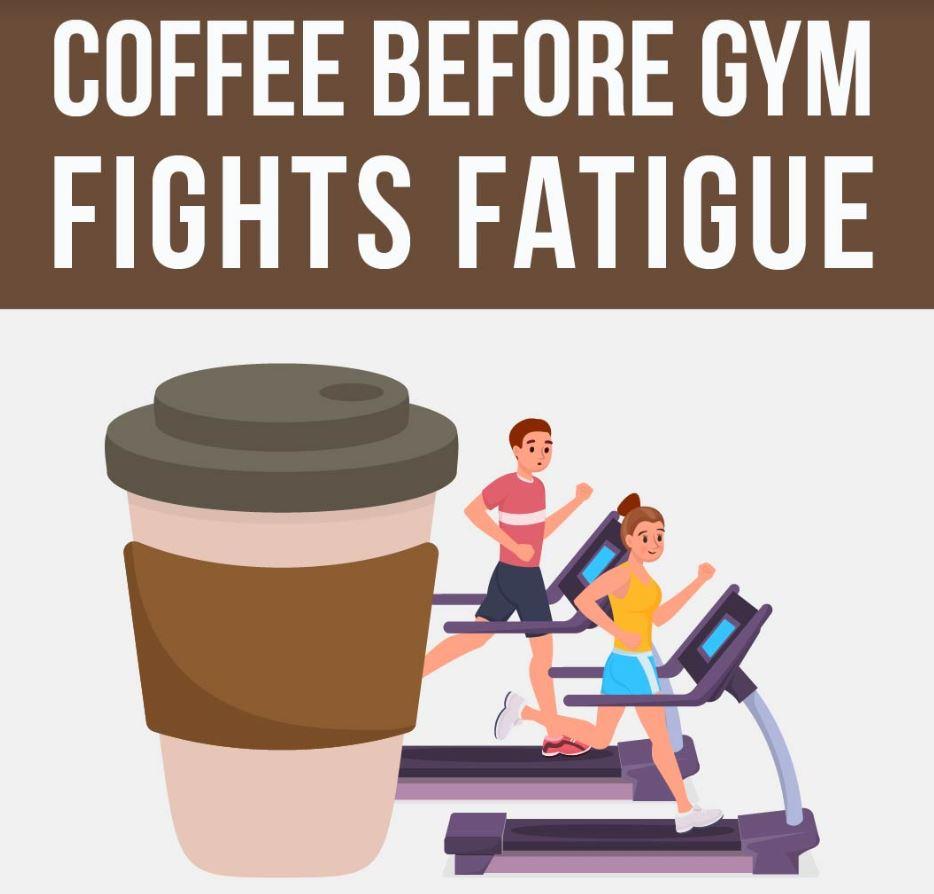
Coffee Before Gym Fights Fatigue
During a hard set, it is usually not the muscle that quits first. It is the decision. When you push to the limit, the sensation of effort climbs faster than your actual capacity falls, and that is the moment people rack the bar.
This is exactly the lever caffeine pulls. In the Doherty and Smith pooled data, the same physical work was rated 5.6% easier on caffeine than on a placebo, with a 95% confidence interval of 4.5% to 6.7% lower. The work did not get lighter. The price of it did.
Coffee Improves Workout Performance
Caffeine before lifting shows up in the rep count. In one trial, 13 resistance-trained men took either 179 mg of caffeine or a placebo 60 minutes before bench press, deadlift, prone row and back squat to failure at 60% of one-rep max. They completed significantly more reps on caffeine (p = 0.015), and rated the effort significantly lower than on placebo (p = 0.02). Note the load: 60% of a one-rep max, not more than it. An earlier version of this post had that backwards.
Across the broader literature, the pooled performance improvement was 11.2% compared to a placebo. Keep that separate from the 5.6% figure above. One is how hard the work felt. The other is how much work got done. They are different measurements, and the paper reports them separately.
This is also where the coffee and weightlifting pairing earns its keep: squat, bench, deadlift and row sets all live in the sustained submaximal range where effort perception decides the last two reps.
Coffee and Exercise for Cardio Endurance
The endurance effect is the best documented of the lot, because that is where most of these studies were run. Constant-load cycling and running dominate the caffeine literature, and that is where the 11.2% figure mostly comes from. If you ride, row, run or do anything long enough to have a back half, this is your effect.
What is not well supported is the old claim that coffee thins or shrinks your blood cells. It does not. The endurance benefit is a central nervous system story and a substrate story, not a plumbing one. We removed that explanation from this post in 2026 because it was wrong, and muscle fatigue deserves a better one.
Drinking Coffee Boosts Metabolism
Caffeine shifts fuel use toward fat during a session. In Costill's 1978 study, nine cyclists rode to exhaustion after 330 mg of caffeine in coffee or after decaf coffee. Fat oxidation was significantly higher on caffeine, 1.31 grams per minute against 0.75 (P < 0.05), and they lasted 90.2 minutes against 75.5. They also rated the effort significantly easier, which is the same finding the 2005 meta-analysis would later pool from 21 studies. Useful, but do not mistake a metabolic nudge for a weight loss plan. The food still decides that.
Coffee Post Workout
Coffee beans carry a real antioxidant load, and a cup afterward is a pleasant thing. What the evidence does not show is caffeine meaningfully speeding muscle repair or reducing creatine kinase after a session. Treat post-workout coffee as something you enjoy, not as recovery technology.
Coffee Pre Workout FAQs
Is it Ok to Drink Coffee Before Workout?
Yes. A cup of coffee before training is one of the best supported performance habits there is, with pooled data showing 5.6% lower perceived effort and 11.2% better performance versus a placebo. Coffee is mildly diuretic, so drink water alongside it, especially on an empty stomach.
Are There Black Coffee Benefits for Weight Loss?
Modestly. Caffeine increases fat oxidation during exercise and slightly raises metabolic rate, but the effect is small next to what you eat. Black coffee is a sensible zero-calorie pre-workout, not a weight loss strategy on its own.
Does Coffee Burn Calories?
A little. Caffeine raises resting metabolic rate for a few hours and can blunt appetite, which is why people reach for it instead of a snack. Do not get hung up on the number; the source of your calories matters more than the count.
When Should I Drink Coffee Pre Workout?
About 60 minutes before you train. That is the timing most of these studies used, and it lines up with when blood caffeine peaks. Thirty minutes still works if you are rushed.
Does coffee make hard sets hurt less?
It makes the work leading up to failure feel easier, but not the failure itself. At the moment subjects actually quit, caffeine changed perceived effort by 0.01%, which was not statistically significant. You get further before you arrive at all-out. All-out feels the same when you get there.
Which Coffee Before Workout is Best?
Pick one you will actually drink, sourced well, with no artificial flavoring. Superior coffee does not need additives.
Then look at the caffeine. PR Blend carries 50% more caffeine than standard coffee and is roasted to order, so one cup before training lands in the dose range these studies used rather than a fraction of it. If you want a lighter option for evening sessions, the rest of the coffee lineup covers it, and the Coffee of the Month annual plan keeps it in the cupboard on the mornings you would otherwise skip it.
This is population level research, not medical advice.